Oxford ICP Etcher (PlasmaPro 100 Cobra): Difference between revisions
→GaN Etch (Cl2/BCl3/Ar/200°C): Added recipe name for GaN |
→Recipes: promoted recipes page to larger heading level |
||
| Line 58: | Line 58: | ||
==Recipes== |
==Recipes== |
||
=== '''[[ICP Etching Recipes#Oxford ICP Etcher .28PlasmaPro 100 Cobra.29|Oxford PlasmaPro Recipes]]''' ← Recipes specific to this tool. === |
|||
*All [[Dry Etching Recipes]] - use this list to see other options for dry etching various materials. |
*All [[Dry Etching Recipes]] - use this list to see other options for dry etching various materials. |
||
Latest revision as of 19:06, 21 September 2025
| ||||||||||||||||||||||||||||||

About
The Oxford PlasmaPro 100 Cobra 300 is intended for etching InP-based, GaAs-baased and GaN-based epitaxies, in addition to Atomic Layer Etching (ALE) processes. The system has a load lock, wide temperature range with rapid heating/cooling, Inductively Coupled Plasma (ICP) coil and a capactively coupled substrate HF (13.56MHz) The fixturing is configured for 4" diameter Si wafers and uses a clamp to hold the sample on the RF chuck. Small pieces may be placed on Silicon carrier wafers, with or without mounting adhesive. Helium back-side cooling is used to keep the sample cool during the etch, but pieces do heat up when placed on carriers.
The in-situ laser monitor installed on this system allows for repeatable etches and endpoint detection via continuous optical monitoring of the wafer reflectivity in a user-determined location, through a porthole on the chamber. The system also has an in situ optical emission monitor for plasma spectroscopy, utilized for chamber clean endpoint detection.
Detailed Specifications
- Temperature Range: –150°C to +400°C
- Gases Available: CH4, H2, Ar, Cl2, BCl3, SF6, SiCl4, O2, N2
- ICP Power (max): 3000 W
- RF Power (max): 600 W
- He-back-side cooling
- 100mm wafer held down with ceramic clamp., single-load
- Users may place pieces onto carrier wafer with or without adhesive. Standard recipes use no adhesive.
- Pieces must be >7mm from edge of carrier to avoid wafer-clamping mechanism.
- Windows-based Cortex software control of process and wafer handling
- Allowed Materials:
- InP-based epitaxies - qualified and ready
- GaAs-baased epitaxies - starter recipe is available
- GaN-based epitaxies - starter recipe is available
- GaSb-based epitaxies - starter recipe is available
- Atomic Layer Etching on select materials - starter recipe is available
- Standard masking materials include:
- SiO2
- Si3N4
- photoresist (at << 100°C).
Other materials can be exposed to the chamber only with staff approval.
- Laser monitoring with camera and etch simulation software: Intellemetrics LEP 500
- Optical Emission Spectroscopy (Ocean Optics) for endpoint detection of chamber cleans & etches - integrated into Oxford software
Documentation
- Oxford PlasmaPro Operating Instructions
- Includes "Travelers" and post-cleaning for each type of standard etch (InP, GaAs, GaN)
- Laser Etch Monitoring procedures
- Online Training Video:
- Oxford Cobra 300 Training
- Important: This video is for reference only, and does not give you authorization to use the tool. You must be officially authorized by the supervisor before using this machine.
Recipes
Oxford PlasmaPro Recipes ← Recipes specific to this tool.
- All Dry Etching Recipes - use this list to see other options for dry etching various materials.
Process Control Data
Click above for calibration etch data for verifying tool performance over time.
Std InP Ridge Etch: Cl2/CH4/H2/60°C
Calibration / Process testing data taken using the "InP Ridge Etch" process: Cl2/CH4/H2 @ 60°C, 1cm piece with ~50% SiO2 hardmask.
- "Std InP Ridge Etch" Cl2/CH4/H2/60°C - Etch Data Tables
- "Std InP Ridge Etch" Cl2/CH4/H2/60°C - Plots
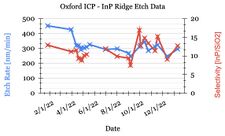
Click for Process Control Charts
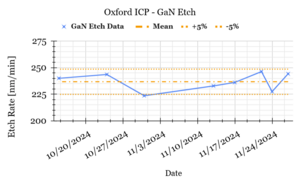
GaN Etch (Cl2/BCl3/Ar/200°C)
Recipe: Std GaN Etch - BCl3/Cl2/Ar - 200C (Public), on 1cm x 1cm ~1.2µm deep GaN etch with Cl2/BCl3/Ar at 200°C. Sapphire substrate with SiO2 mask for GaN.